
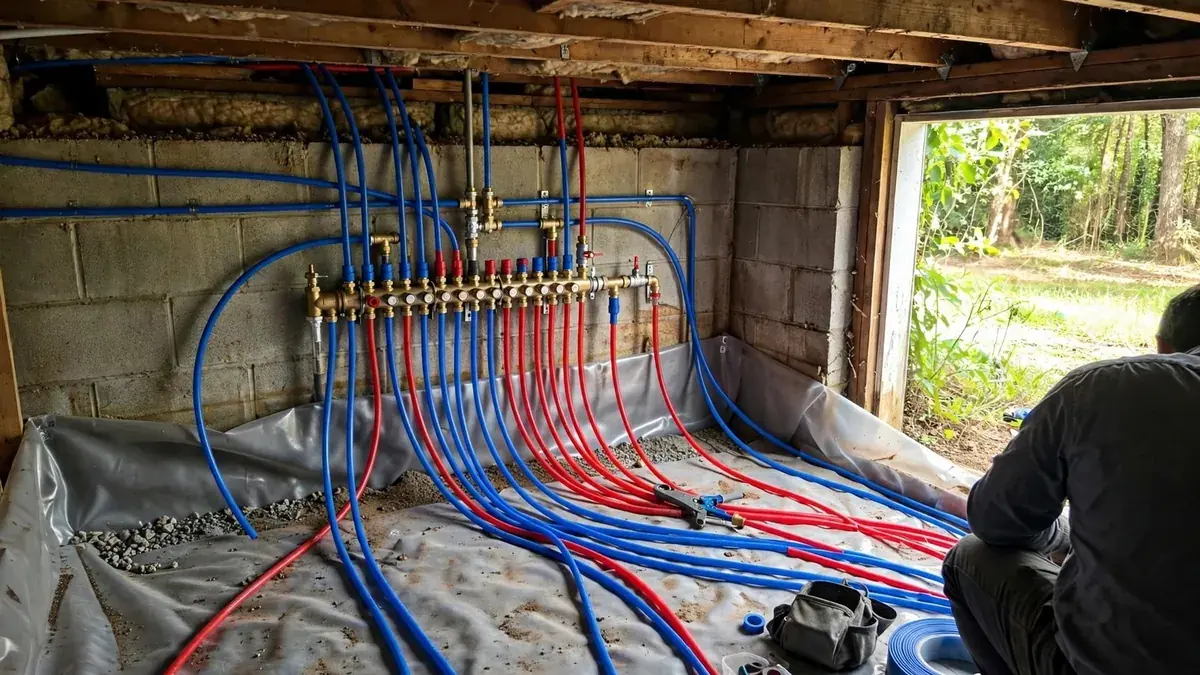
Repiping a house is one of the larger plumbing projects an owner faces. Prices vary because homes vary. A one-story ranch with open basement ceilings is a different job from a two-story house with finished walls. This guide explains the pieces of a repipe quote and how to compare bids.
We leave out dollar figures because the right number depends on a survey. What matters is that you can see what is in the bid.
The material you choose
PEX is flexible, uses fewer fittings and is faster to install, which usually makes it the lower-cost option. Copper is rigid, has a long record and costs more in material and labor. CPVC is a third choice, though it can become brittle with age.
| Material | Cost level | Notes |
|---|---|---|
| PEX | Lower | Fast install, keep from sunlight |
| Copper | Higher | Long track record, rigid |
| CPVC | Lower to moderate | Brittleness over time |
How many fixtures and how far apart
Every sink, toilet, tub, shower, washer and hose bib needs a supply line. More fixtures mean more runs. Fixtures far from the main mean longer pipe. A home with three bathrooms and a kitchen costs more than a home with one.
Access: open joists or finished walls
The biggest swing in cost is access. In an unfinished basement, pipes can be run along the joists with little damage. In a finished house, each run may need an opening in drywall or plaster. Slab-on-grade homes may need to run lines through the attic or walls.
Wondering if your pipes are due?
Call and we survey the system and explain options.
Finish work is not in the plumber's bid
Drywall repair, painting and flooring are other trades. Ask whether the bid includes opening and closing walls, and who handles finish work. A low bid that leaves you with holes and no plan is not a bargain.
Signs repiping may be due
- Repeated pinhole leaks, especially in copper
- Brown water when you run the tap after being away
- Low pressure that has gotten worse
- Galvanized steel pipe
- Polybutylene pipe, a grey plastic used in some homes
One leak is a repair. A pattern of leaks is a warning. Our leak detection service helps you tell the two apart.
A timeline from survey to finished walls
- 1
Survey and quote
One visit to trace lines, count fixtures and note access. You get a written scope.
- 2
Scheduling
Pick a start date that suits the household. Plan for a few days without normal water use.
- 3
Rough-in
New lines are run through basements, attics and walls. Old lines are cut off.
- 4
Pressure test
The new system is filled and held at pressure to prove it is tight.
- 5
Closing up
Access holes are patched by a finish contractor.
Ask about water use during the job. Many repipes keep a kitchen sink or bathroom live while another section is worked on. Others shut water off for the working day and restore it each evening.
Mistakes that drive up cost
Changing fixtures mid-project is the top one. A new vanity or shower choice after the rough-in forces rework. Hiding a known leak is another, because a hidden leak shows up as a surprise. Skipping the shutoff valve upgrade is a third. A main valve that will not close is the first thing you will want after a repipe, and replacing it is a small cost during the work.
Home age and what we typically find
Homes from different eras fail differently. Older houses may have galvanized steel that corrodes from the inside. Houses from the 1980s and early 1990s may have polybutylene, a grey plastic with a poor failure record. Copper from the middle decades can develop pinholes. Newer houses with PEX or CPVC rarely need a repipe at all, and a leak there is usually a single failed fitting.
Financing the project without surprises
Because a repipe is a large one-time expense, some owners phase it. They replace the worst section first, such as the bathroom or kitchen lines, and plan the rest around a remodel. A phased plan only works if the first phase is tied into the old system correctly, so ask the plumber to document the connection points.
What to know in Savage
The City of Savage's most recent lead and copper sampling found 0 of 32 sampled homes above the action level, with the next required test in 2027. That describes the city system at the tap, not what is in your home's pipes.
The City buys about 71.5 percent of its water from Burnsville, whose 2025 report states hardness of 25 to 26 grains per gallon. Plan for water treatment with any new plumbing, and check a contractor's license through the state Department of Labor and Industry.
Source type: City water quality report and state agency page
Code and sources
Under the Minnesota Department of Labor and Industry, the governing standard is Minnesota Rules chapter 4714, built on the 2018 Uniform Plumbing Code with state amendments. This page is general information, not a code review of your home, and your city building department answers permit questions.
Comparing bids
- Same pipe material in each bid?
- Same number of fixtures and hose bibs?
- Is the main shutoff replaced?
- Who opens and closes walls?
- What is the warranty on labor?
If the problem sits outside your walls, see water service line repair. We serve Savage and homes in Burnsville and Lakeville.
Questions Savage homeowners ask
Often a few days for a typical home. The survey gives a schedule.
Usually not. Water is off for part of each day.
Both work well. The choice depends on budget, access and preference.
The City's most recent sampling found no homes above the action level. Your own pipes are a separate question.
A single leak is a repair. A pattern of leaks suggests a plan.
Still have a question about your situation? The line is open around the clock. Call (952) 866-9120