
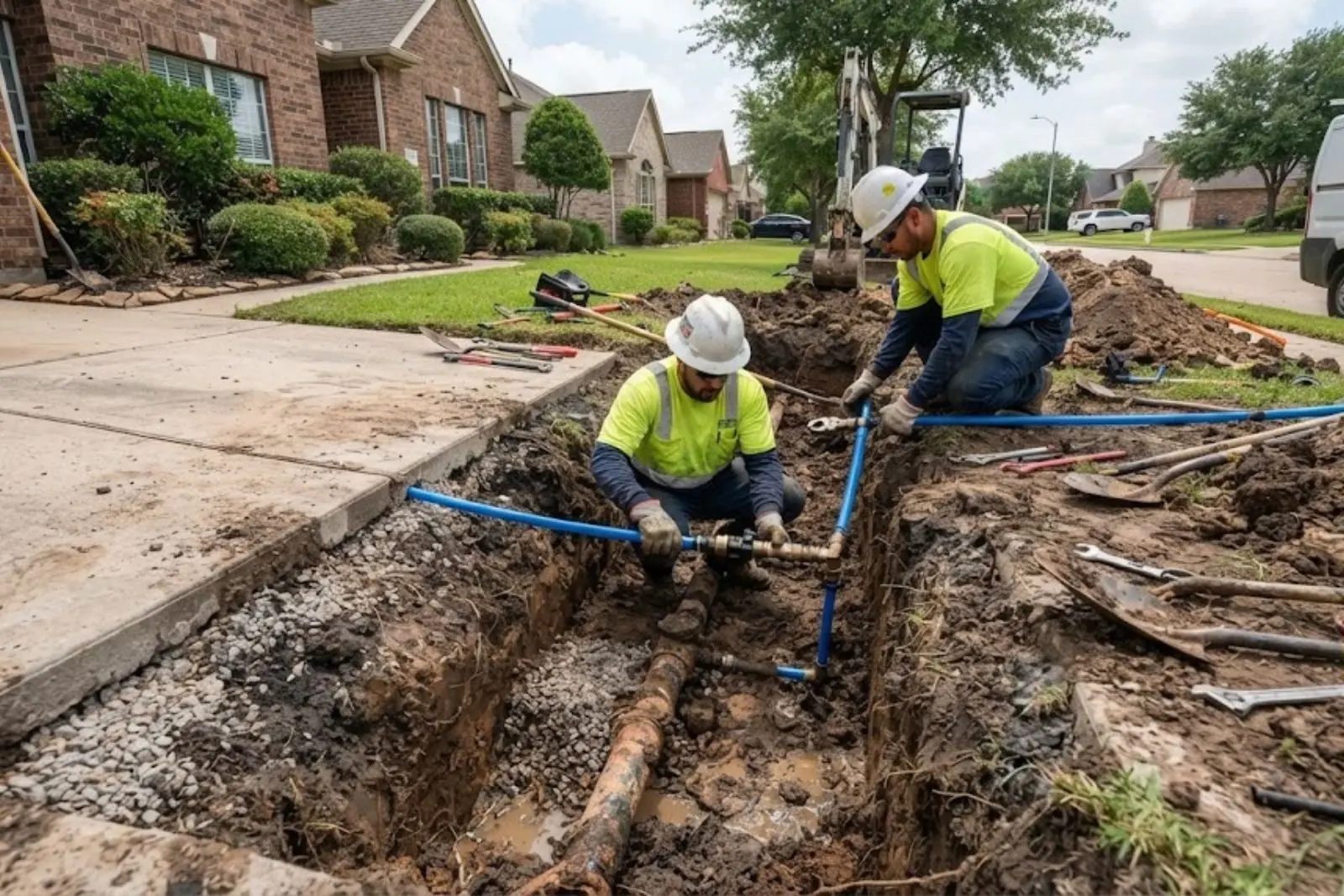
The water service line runs from the main in the street, through the meter, to your home. When it leaks or breaks, you may see a wet or sunken patch in the yard, lose pressure or watch your meter run. We answer 24/7 in Savage for service line trouble, and same-day visits are often possible.
If water is flowing heavily, close the main valve inside the house. If the leak is before the meter, ask your utility to shut off at the street.
When a service line leak is an emergency
- Water bubbling in the yard or driveway
- No water or very low pressure at every tap
- A meter that moves with all fixtures off
- Muddy water after a sudden pressure drop
- Ground that is soft, sunken or green in one strip during winter
Repair or replace the line
| Option | Good for | Notes |
|---|---|---|
| Spot repair | One failed section | Needs excavation at the break |
| Trenchless replacement | Long run, good access at both ends | Less surface damage |
| Full trench replacement | Old lead, galvanized or collapsed line | Most disruptive, most lasting |
| Partial replacement | Only a section is old | Check material at the connection |
Yard soaked or no pressure?
Call the 24/7 line and we start with a meter check.
Lead and old pipe: what Savage and neighbors know
Old service lines may be lead, galvanized steel or copper. Shakopee Public Utilities, a neighbor, lists service line counts in its 2025 report, including five lead, eleven galvanized lines requiring replacement and more than a thousand of unknown material. That shows why material is worth checking for any home.
In Savage, recent lead and copper sampling found 0 of 32 homes above the action level. The City's next required test is in 2027. Ask City of Savage Utility Services what they know about your line.
How a repair visit goes
- 1
Confirm the leak
Meter and pressure tests tell us the line is losing water.
- 2
Call 811
Gopher State One Call marks buried utilities. Minnesota asks for at least 48 hours notice, not counting weekends and holidays, and the service is free.
- 3
Excavate or pull a new line
We open the smallest area that works.
- 4
Reconnect and test
New pipe and fittings are pressure-tested before backfill.
- 5
Restore
We backfill and leave the ground ready for final landscaping.
What your utility and your plumber each handle
A water service line crosses a boundary. The utility owns the main in the street and usually the tap that connects to it. The homeowner usually owns the pipe from there to the house. The meter and curb stop sit near that boundary. Because ownership and shutoff authority differ, a leak before the meter can require a call to the utility, while a leak after it is yours to repair.
We help you work out which side the leak is on and we coordinate shutoff and inspection with the utility. Ask City of Savage Utility Services about your address before work begins so nothing is done twice.
If the line is old, replacing the whole private run is often cheaper than repairing the same pipe again next year. We show you both quotes.
Cost factors
Service line projects vary by length and depth. We give a clear price before work starts.
The homeowner usually owns the line from the meter or curb stop to the house. Ask your utility where responsibility begins and ends.
Related: burst pipe repair for sudden breaks and repiping for the lines inside. We serve Savage and nearby Shakopee and other towns.
Code and sources
According to the Minnesota Department of Labor and Industry, plumbing work in the state follows Minnesota Rules chapter 4714, which incorporates the 2018 Uniform Plumbing Code with Minnesota amendments. Rules for permits and inspections vary by city, so ask your city's building department what your project needs.
Common questions
Yes. The line is open 24/7, and same-day service is offered when we can.
The homeowner typically owns from the meter or curb stop to the house. Ask the City of Savage utility office.
Where a line is lead or galvanized, we can replace the private side. Coordination with the utility may be needed.
A meter that runs with everything off, wet ground or low pressure are common clues.
Trenchless methods reduce it. We explain which one fits.
Still have a question about your situation? The line is open around the clock. Call (952) 866-9120