
Tankless water heaters are often described as long-lived, and they can be. Manufacturers commonly say they outlast tanks. But a unit in hard water that is never maintained can fail early. This guide explains the realistic range and the habits that decide where you land.
A realistic range
Manufacturers often quote about twenty years for a well-maintained tankless unit, compared with roughly a decade for a conventional tank. Treat these as ranges, not promises. The actual life depends on water quality, use and care.
A tankless unit has a heat exchanger with narrow passages. Anything that coats or clogs those passages shortens life. The main enemy is scale.
| Factor | Effect | What to do |
|---|---|---|
| Hard water | Scale narrows passages | Flush yearly, consider a softener |
| Annual maintenance | Extends life | Schedule a descaling flush |
| Sizing | An undersized unit works at its limit | Match to peak demand |
| Venting and gas supply | Poor supply stresses the burner | Correct at install |
| Freezing | Can crack the heat exchanger | Keep the unit in a heated space |
The flush
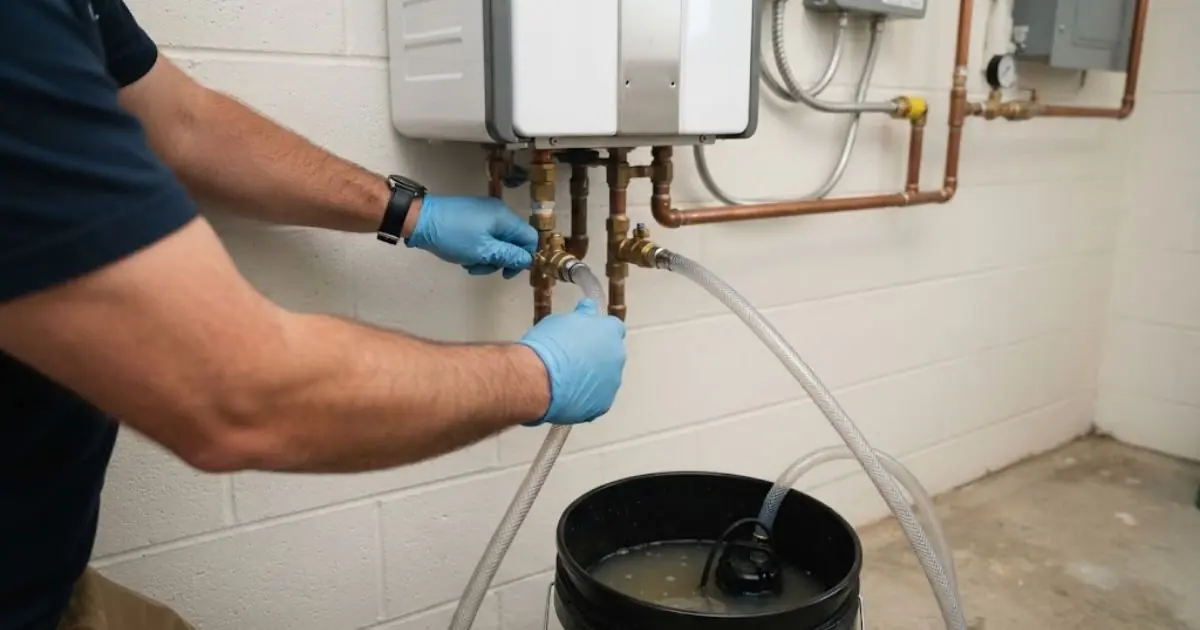
A descaling flush circulates a mild acid solution through the heat exchanger for an hour or so, then rinses it. The installer connects hoses to the isolation valves, runs a small pump and reads the condition of the solution. Heavy scale turns it cloudy.
In hard water areas, many owners flush once a year. A unit with no isolation valves cannot be flushed easily, which is why we install them.
Haven't flushed your tankless unit?
Call and we schedule a descaling flush.
Warning signs
- Error codes that return after resets
- Water that cycles between hot and cold
- Reduced flow or lukewarm water
- A rumbling or kettle sound
- Higher gas use for the same hot water
These can mean scale, a clogged inlet screen or a venting issue. Catching them early can add years.
Repair or replace
Parts like igniters, sensors and fans are often replaceable. A heat exchanger that has failed is expensive and may not make sense on an older unit. Ask for a comparison.
Tankless in cold climates
Incoming water in Minnesota winters is very cold, so a tankless unit has to raise the temperature further than it would in a mild climate. The result is a lower maximum flow at the same set point. A unit that serves two showers in summer may only serve one in January.
Size for winter, not summer. Ask the installer for the flow rate at your coldest expected inlet temperature.
What a service visit covers
- 1
Read error history
Stored codes show past faults.
- 2
Clean the inlet screen
Debris here starves the unit.
- 3
Flush with descaler
Mild acid circulated through the heat exchanger.
- 4
Check combustion and venting
Clean burner flame and clear exhaust.
- 5
Test flow and temperature
Confirm it meets the set point.
A service visit is far cheaper than a replacement. It also tells you how much life is left, which is useful if you are deciding whether to replace in a remodel.
Replacement signs versus repair signs
Repair signs are parts-level: an igniter that fails, a flame sensor that needs cleaning, a flow sensor stuck, a clogged inlet screen. Replacement signs are system-level: a leaking heat exchanger, repeated scale failures despite flushing, a manufacturer that no longer makes parts and a unit whose output has dropped well below its rating.
When a unit is more than a decade old and fails in a major way, ask for a side-by-side of repair and replacement. A newer unit may be more efficient and come with a fresh warranty.
How hard water changes the expected life
The ranges you see in brochures assume decent water and a service schedule. In hard water without a softener or flushing, expect the low end or less. In treated water with yearly flushes, expect the high end. That is why we tie the lifespan question to the water question every time.
Keep a log of each flush with the date and what the rinse water looked like. A heavy, cloudy rinse in year three tells you the schedule needs to tighten before damage sets in.
What to know in Savage
The City of Savage buys about 71.5 percent of its distributed water from Burnsville, whose 2025 report states hardness of 25 to 26 grains per gallon. Savage's own report does not list a hardness figure. Test your tap and ask City of Savage Utility Services what your address receives.
Minnesota winters are cold enough to freeze a unit installed in an unheated garage or an exterior wall. Keep tankless units in conditioned space or use the freeze protection the maker specifies.
Source type: City water report and manufacturer guidance
Code and sources
Under the Minnesota Department of Labor and Industry, the governing standard is Minnesota Rules chapter 4714, built on the 2018 Uniform Plumbing Code with state amendments. This page is general information, not a code review of your home, and your city building department answers permit questions.
How to get the long end of the range
- 1
Install with isolation valves
They make the flush possible.
- 2
Treat the water
A softener upstream slows scale.
- 3
Flush yearly
More often in very hard water.
- 4
Clean the inlet screen
A clogged screen starves the unit.
- 5
Keep it heated
Protect from freezing.
If a unit needs work, our tankless water heater service covers flushing and repair, and if you are weighing a swap, our water heater installation page covers tank options. We service units in Savage and in Prior Lake and Shakopee.
Questions Savage homeowners ask
Often cited as around twenty years with maintenance. Hard water and neglect shorten that.
Once a year is a common minimum. Very hard water may call for more.
Yes if it is in an unheated space.
Not always, but it protects the heat exchanger in hard water.
A cleaning that circulates mild acid through the heat exchanger.
Still have a question about your situation? The line is open around the clock. Call (952) 866-9120