
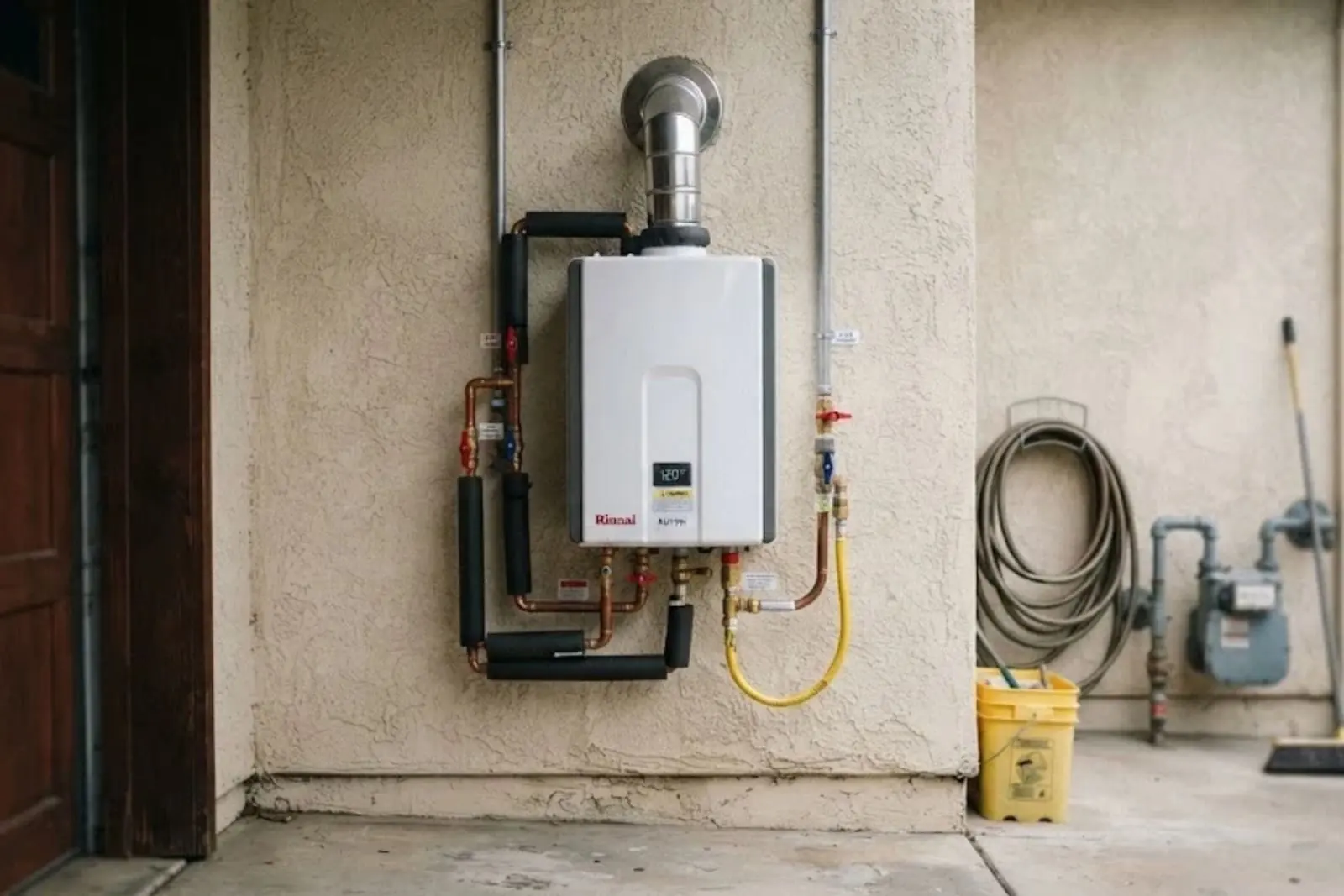
A tankless unit heats water as it flows, so you do not run out in the middle of a shower. In Savage it works best when it is sized to the home and maintained against hard-water scale. We install, flush and repair tankless units, and we say plainly when a tank is the better fit.
Is tankless right for this house?
Tankless saves floor space and can last longer than a tank when it is flushed on schedule. It also needs a bigger gas line, a proper vent and, for electric models, a heavy electrical supply. Many older homes need more work to make that happen.
| Factor | Tank | Tankless |
|---|---|---|
| Upfront cost | Lower | Higher, with venting and gas work |
| Hot water supply | Limited by tank size | Continuous, limited by flow rate |
| Space | Needs a floor footprint | Wall-mounted, small |
| Maintenance | Flush and anode rod | Annual descaling flush |
| Typical life | Shorter | Longer with maintenance |
These are general patterns. The right answer depends on your home, your gas supply and how you use hot water.
Hard water and tankless units
Savage buys most of its water from Burnsville, and Burnsville reports hardness of 25 to 26 grains per gallon. Scale forms fastest inside the narrow passages of a tankless heat exchanger. A unit in hard water that never gets flushed can lose output, throw error codes or fail long before its time.
We service this with a descaling flush using a pump and a descaling solution, then check the inlet filter and water flow. In homes with hard supply, a water softener before the heater is the more lasting answer.
Considering a tankless upgrade?
Call and we check your gas line, vent route and flow needs first.
What an install involves
- 1
Calculate flow
We add up the fixtures that run together and the temperature rise your incoming water needs.
- 2
Check the supply
Gas line size, regulator, venting, power for the fan and condensate drain are all checked.
- 3
Install
The unit mounts on the wall, with isolation valves so it can be flushed later.
- 4
Commission and teach
We test flow and temperature, show you the settings and mark the flush valves.
Repairs and flush service
Error codes, a unit that cuts out between showers, weak hot flow and a cold sandwich effect (hot, cold, hot) all have causes we can trace. Often it is scale, a clogged inlet screen or a venting problem. We read the code, test the flow and explain what we found.
If your unit is a few years old and has never been flushed, call sooner than later. Heavy scale can need a longer cleaning and sometimes a part.
Gas line and venting: the part most quotes gloss over
A gas tankless unit burns far more gas per minute than a tank burner, even though it runs for less time. If the existing gas pipe is sized for a tank, the unit may starve at peak flow and shut itself off. We measure the run from the meter and check the regulator before we promise anything.
Venting is the other surprise. Condensing units produce acidic condensate that needs a drain and approved vent material. Older chimney venting rarely works. We walk the vent route with you during the site check so the quote includes it.
Cost factors
Tankless projects have more variables than tank swaps. You get a full quote after we see the site.
A tankless upgrade is a planned improvement, not covered by home insurance. A flush is a small recurring cost that protects the large one.
For a failed unit we can discuss water heater repair or a swap. If space is tight, a conventional tank through water heater installation is still a good choice. Our work covers Savage and surrounding towns including Burnsville.
Code and sources
According to the Minnesota Department of Labor and Industry, plumbing work in the state follows Minnesota Rules chapter 4714, which incorporates the 2018 Uniform Plumbing Code with Minnesota amendments. Rules for permits and inspections vary by city, so ask your city's building department what your project needs.
Common questions
Once a year is a common recommendation, and with hard water some owners flush more often. Check your manual for the maker's schedule.
Not always. Gas line size, venting and electrical capacity decide it. We check before we quote.
Often scale, a blocked inlet screen, a venting issue or a flow problem. The code points us to the right test.
Not always. Savings depend on your use and the unit. We discuss realistic expectations with you.
We service common brands and tell you up front if a part is hard to source.
Still have a question about your situation? The line is open around the clock. Call (952) 866-9120