
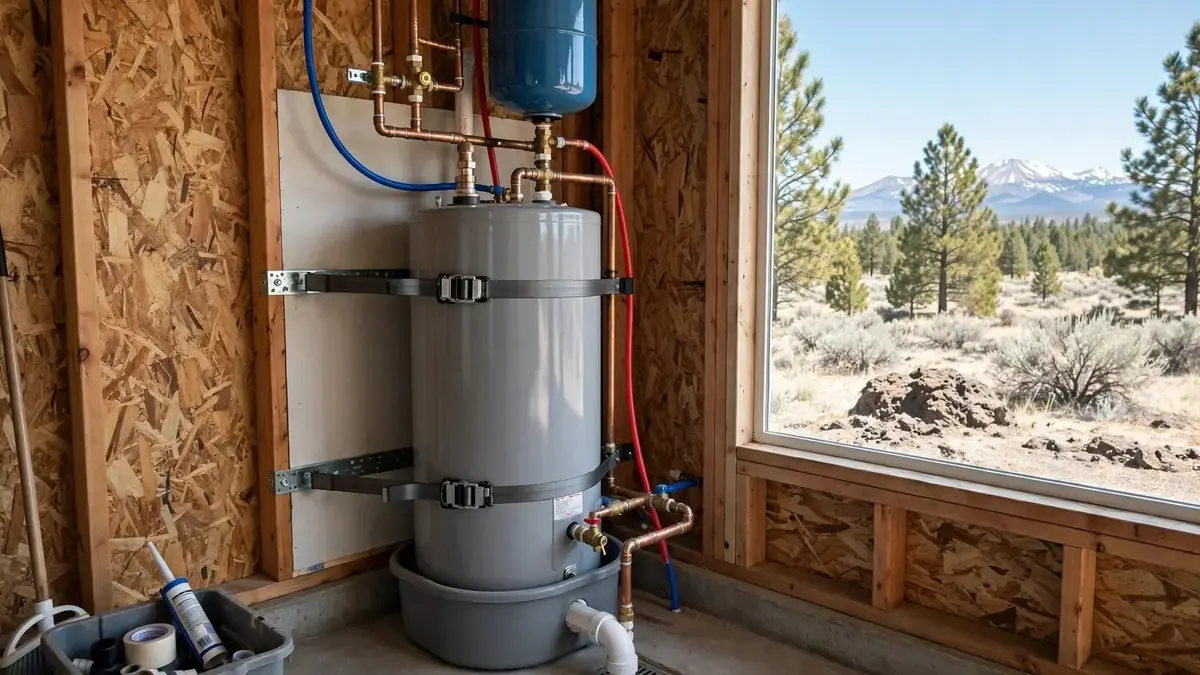
A planned water heater installation goes better than a flooded-basement scramble. This page covers new tank installs, upgrades during a remodel and moving a heater to a better spot in Savage homes. If your tank is leaking right now, start with our emergency page and come back here when the water is off.
Size the tank to the household
Capacity is not a guess. We count bathrooms, adults, teens and whether a soaking tub fills at the same time as the dishwasher runs. A two-person household and a family of five need different tanks, and a bigger tank than you need costs more to heat every day.
| Household | Common tank range | Notes |
|---|---|---|
| One to two people | 30 to 40 gallons | Single bath, light use |
| Three to four people | 40 to 50 gallons | Most common family size |
| Five or more, or a large tub | 50 to 75 gallons, or tankless | Peak demand drives the choice |
These ranges are common starting points, not promises. Recovery rate and first-hour rating matter as much as the tank size printed on the label.
Fuel, venting and location
Gas units need a vent path that meets the manufacturer's rules and a gas shutoff within reach. Electric units need the right breaker and wire gauge. Heat pump (hybrid) models need room for air flow and a drain for condensate. We check each before we quote.
Savage basements are often finished or partly finished. A drain pan with a pipe to a floor drain or sump is a small add-on that prevents a big loss if the tank ever fails.
Ready to plan an install?
Call us and we walk through fuel, size and layout before anyone orders a tank.
What an installation includes
- 1
Site check
We measure the space, check clearances, shutoffs, vent route and the electrical or gas supply.
- 2
Choose the unit
You pick the size and efficiency level with our notes on running cost and warranty terms.
- 3
Install and connect
New supply lines, a temperature and pressure relief valve with a discharge pipe, a drain pan where it fits, and an expansion tank where the system needs one.
- 4
Commission
We fill, purge, light or power, test pressure and set the temperature.
Ask the City of Savage building department whether your install needs a permit. Rules vary by job and we help you with the paperwork when one applies.
Savage-specific points
Hardness in the supply Savage buys from Burnsville is reported at 25 to 26 grains per gallon. A new tank will scale up sooner than you expect without a softener, so we raise the topic during the site check. See our water softener and filtration page for what that adds.
Newer builds near the Highway 13 corridor often have a utility room with floor drain access. Older homes in the Hamilton District can have tight closets or shutoffs that have not turned in decades, and we price the extra work honestly.
Questions to settle before the install day
Decide where the old unit's drain will run, whether you want a recirculation loop for faster hot water at distant fixtures, and what temperature you want it set to. A setting near 120 degrees balances scald risk and comfort for most households. Tell us if someone in the home is very young or elderly and we adjust the plan.
What changes the price
An install is a package of unit, labor, venting and extras. You get one clear number before work starts.
Insurance does not cover an upgrade you choose to make. It sometimes covers damage if an old tank bursts, which is another reason to replace on your schedule.
Related choices
If you want endless hot water, a tankless water heater changes the space, gas and venting needs. If you are replacing a failed tank, replacement is the faster route.
We install in Savage and in Lakeville and other nearby towns.
Code and sources
According to the Minnesota Department of Labor and Industry, plumbing work in the state follows Minnesota Rules chapter 4714, which incorporates the 2018 Uniform Plumbing Code with Minnesota amendments. Rules for permits and inspections vary by city, so ask your city's building department what your project needs.
Common questions
A like-for-like tank swap takes a few hours. Moving the heater or changing fuel types takes longer and may need a second visit.
Many closed systems benefit from one. We check your supply pressure and whether a check valve or pressure reducing valve is already present.
Often yes. Distance to the vent, gas or power and the drain all affect the cost.
Yes, it is part of the visit.
That depends on your household and fixtures. Tell us who lives in the home and we suggest a range.
Still have a question about your situation? The line is open around the clock. Call (952) 866-9120