
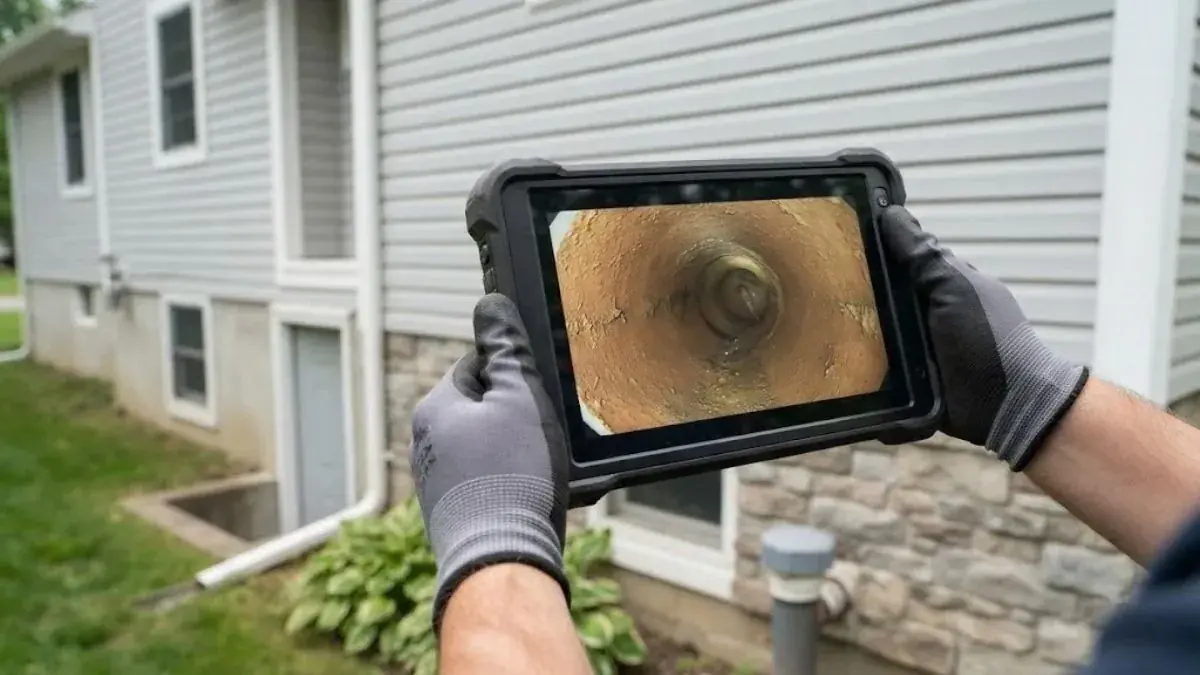
A sewer camera inspection puts a waterproof lens on a flexible cable and feeds it through the line from the cleanout toward the street. The video shows the pipe wall, the joints and anything inside. It is the fastest way to turn a guess into a diagnosis.
We do planned inspections for buyers, for homeowners with repeat clogs and for anyone about to pay for a repair they want confirmed first. If sewage is already backing up, our urgent sewer pages are the better starting point.
Who benefits from an inspection
- Home buyers who want to know what is under the lawn before closing
- Owners whose drain clogs every few months
- Anyone who got a sewer repair quote and wants a second look
- Owners of older homes with clay, cast iron or orangeburg pipe
- Properties with big trees near the line
Buying a house in Savage's older core, including the Hamilton District near Highway 13, is a good time to scope. The lateral may be decades old, and a camera costs far less than a surprise repair.
What the camera can show
| Finding on camera | What it suggests | Typical next step |
|---|---|---|
| Roots entering at joints | Joint failure | Cut, jet and consider lining |
| Pipe sagging with standing water | A belly in the line | Spot repair or replacement |
| Cracked or broken wall | Impact or age damage | Lining or section replacement |
| Scale or grease coating | Buildup narrowing the bore | Hydro jetting |
| Offset joint | Ground movement or poor install | Spot repair |
| Clean pipe with no defects | Problem may be elsewhere | Check fixtures and vents |
Want eyes on the line?
Call and book a camera inspection with a clear price before work starts.
How an inspection works
- 1
Find access
We use a cleanout, or pull a toilet if the house has none.
- 2
Run the camera
The cable feeds in while we watch the monitor and note distances.
- 3
Locate
A transmitter in the camera tells us where defects sit on the surface and how deep.
- 4
Review the footage
We show you the images, mark them on a simple map and explain what matters.
What Savage buyers and owners should know
The City of Savage owns the water and sewer mains, and the homeowner usually owns the lateral that connects the house. Ask City of Savage Utility Services where the dividing line sits for your address. That tells you what your camera footage is worth when you negotiate a repair.
Minnesota's Gopher State One Call service, reached by dialing 811, is free and requires at least 48 hours notice before digging, not counting weekends and holidays. We raise it whenever an inspection leads to excavation.
Reading the footage with us
Camera footage looks alarming to anyone who has not seen it before. Roots look like hair, scale looks like rust and a normal joint looks like a seam. We narrate the video, pause on each finding and tell you whether it is cosmetic, worth watching or worth fixing. You leave knowing which three findings matter and which ten do not.
If you live in the Hamilton District and are thinking about an inspection, that page lists what the city has published about the area and how to find out what your own water line is made of.
Cost factors
An inspection is a modest cost compared with a surprise repair. These items change it.
Insurance seldom pays for an inspection. A buyer can ask the seller whether they will accept a camera result as a contingency.
If footage shows roots, see sewer line cleaning. If it shows damage, our crew moves to repair. We scope lines in Savage and in Prior Lake and other towns we serve.
Code and sources
Under the Minnesota Department of Labor and Industry, the governing standard is Minnesota Rules chapter 4714, built on the 2018 Uniform Plumbing Code with state amendments. This page is general information, not a code review of your home, and your city building department answers permit questions.
Common questions
Often under an hour once we have access. Long lines or cleaning first can add time.
Yes. You can keep the footage and any notes.
Usually, by pulling a toilet, though that is more work. We suggest installing a cleanout if you do not have one.
Yes. The locator tool gives depth and position at the surface.
It shows the problem. Fixing is a separate step with its own quote.
Still have a question about your situation? The line is open around the clock. Call (952) 866-9120