
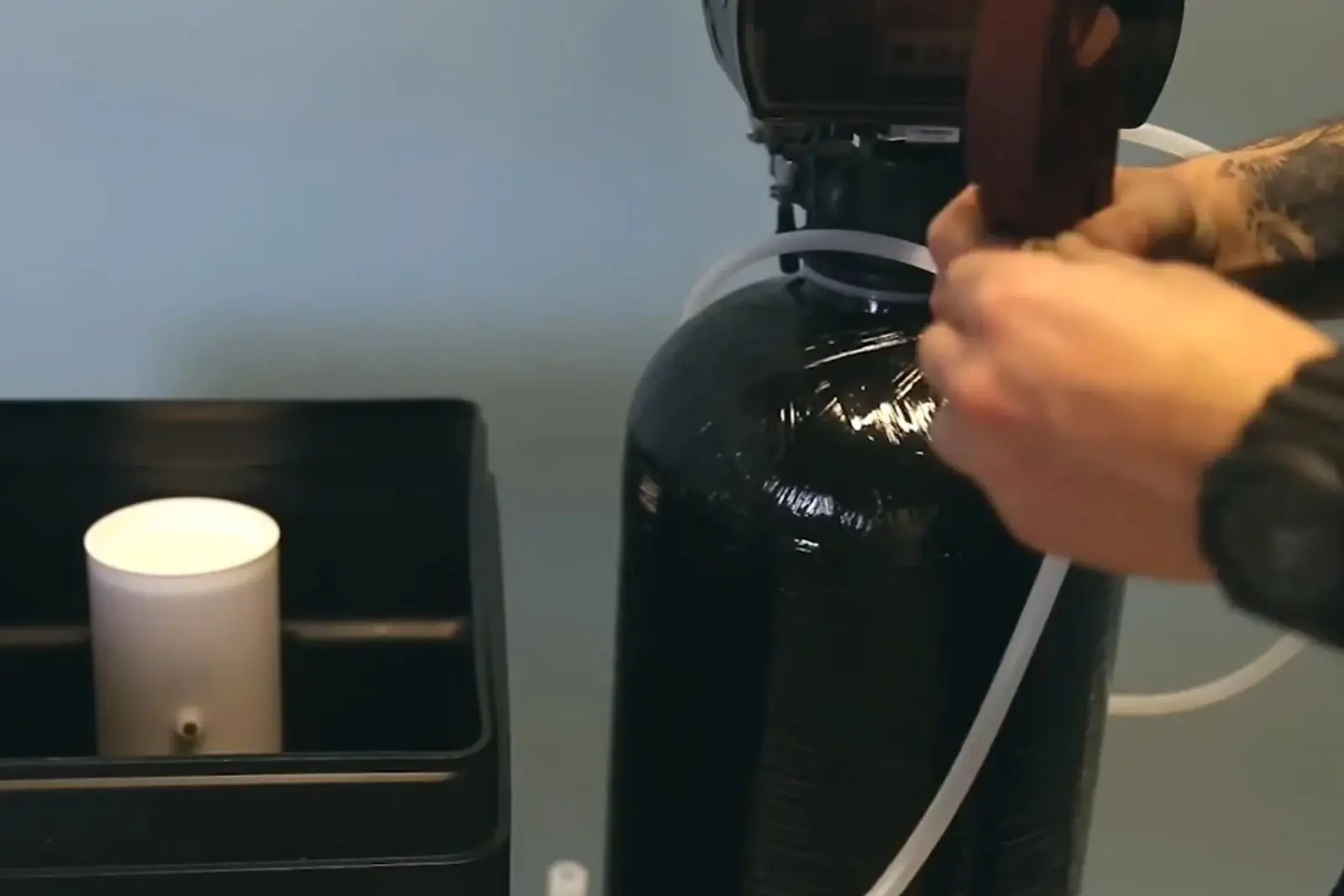
A puddle by the softener is easy to ignore and expensive to leave. Softeners have several places to leak, and each has a different cause. This guide walks through the likely sources so you can decide whether it is a quick fix or a service call.
Where softeners leak
| Where | Likely cause | Fix |
|---|---|---|
| Brine tank overflow | Float stuck or valve failure | Reset float, service the valve |
| Control valve top | Worn seal or cracked valve | Replace seals or valve |
| Drain line | Loose clamp or crack | Tighten or replace |
| Bypass valve | Worn O-rings | Replace O-rings |
| Bottom of the resin tank | Crack or failed fitting | Replace the tank or fitting |
| Brine line fitting | Cracked nut or ferrule | Replace the fitting |
Start by drying everything, then watch for the first drip. Note whether it appears during regeneration, when the softener flushes and refills.
Brine tank overflow
If the brine tank is full of water far above the salt, the fill valve may be stuck open or the brine line may be clogged. Salt bridges, hard crusts that form above the water line, can also confuse the system. Break up a salt bridge gently with a broom handle.
Valve and seal leaks
The control valve is a stack of seals and spacers. In very hard water, scale and grit wear them. A rebuild kit can bring an older valve back. If the valve is cracked or the housing is warped, replacement is the answer.
Water on the floor around your softener?
Call and we trace the leak and fix it.
Drain line problems
The drain line carries brine and rinse water to a floor drain or standpipe. It must have an air gap, a space that prevents backflow. A kinked or clogged drain line causes overflow. A loose clamp leaks a little with every cycle.
Safe handling
- Switch the softener to bypass to stop the flow
- Unplug the control head before working on it
- Do not pry on plastic fittings
- Wipe salt away from electrical parts
- Take photos in case you need a warranty claim
How a softener works, so you can spot the failure
A softener holds a tank of resin beads that attract the minerals that cause hardness. When the beads fill up, the control valve sends salty brine through them, which washes the minerals away down the drain. Then it rinses and refills the brine tank with fresh water to make more brine.
Every leak lives along that cycle. A leak during backwash points at the drain line or the valve. A leak during refill points at the brine tank, float or fill tube. A leak at all times points at the tank, the bypass or a fitting.
Timing the leak
- 1
Dry everything
Wipe the unit and floor so a new drip is easy to see.
- 2
Check at rest
Look an hour later with no cycle running.
- 3
Start a manual regeneration
Most heads have a button. Watch each stage.
- 4
Note the stage
Backwash, brine draw, rinse or refill. Tell us which one.
That timing tells a technician where to look before opening the unit, and it keeps a simple fix from becoming a replacement.
When to replace the whole unit
- The resin tank is cracked
- The control head has failed more than once in a few years
- The unit no longer softens water even after a rebuild
- Parts for the model are no longer sold
- Repair quotes approach the price of a new softener
A newer unit may regenerate more efficiently, using less salt and water. In a home with very hard water, that saving adds up over the years.
If you are buying a new unit, ask for one sized to your actual hardness and household, and ask the installer to leave a drain with an air gap. That one detail prevents a common source of water damage.
Before you call, take a photo of the leak and the control head with its model label. It speeds the diagnosis.
Finally, check the salt level and the salt type. Rock salt leaves more residue than pellets and can clog the brine well, which causes overflow. If you switched types recently and the leak began after, say so when you call.
What to know in Savage
The City of Savage's radium update says softening, reverse osmosis and distillation may help reduce radium, and that carbon filters are not recommended because radium can build up in them. If your softener is part of that approach, keep it working and ask the installer how the unit performs.
Burnsville's 2025 report states hardness of 25 to 26 grains per gallon, and Savage buys about 71.5 percent of its distributed water from Burnsville. Savage's own report does not list hardness, so test your tap.
Source type: City utility pages and neighboring city water report
Code and sources
Under the Minnesota Department of Labor and Industry, the governing standard is Minnesota Rules chapter 4714, built on the 2018 Uniform Plumbing Code with state amendments. This page is general information, not a code review of your home, and your city building department answers permit questions.
Repair or replace
A softener often lasts well over a decade with good care. A leaking valve on a young unit is worth repairing. A cracked resin tank or a unit that has lost capacity may be time for a new one. Our softener page covers installation, and our faucet repair page covers the hardness damage you may see elsewhere.
We serve Savage and nearby towns, including Lakeville and Burnsville.
Questions Savage homeowners ask
It is mostly a nuisance and a floor-damage risk. Put it in bypass and call.
A stuck float or a faulty valve is the usual cause.
Check monthly. The tank should stay above a minimum level.
The City says softening may help reduce radium. Ask your installer about your specific unit.
Many last well over ten years with care.
Still have a question about your situation? The line is open around the clock. Call (952) 866-9120