
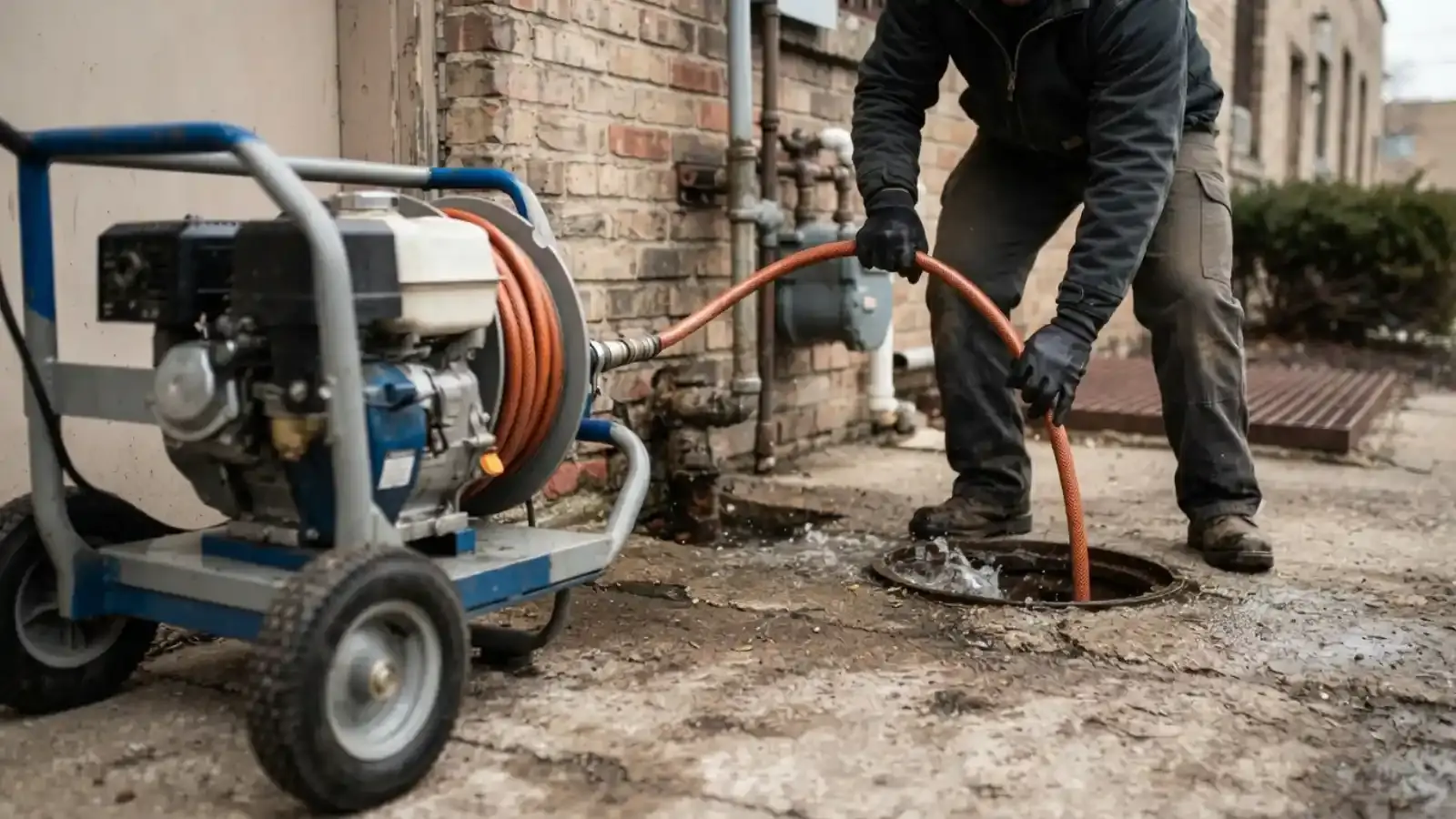
A sewer line that keeps clogging after being cabled is a common complaint. A cable cuts a hole through the clog and leaves much of the buildup on the pipe wall. Hydro jetting uses water pressure to scour the pipe clean. This guide explains how it works, when it helps and when it does not.
What hydro jetting is
A hydro jetter is a pump and a hose with a nozzle on the end. The nozzle sprays water backward at an angle, which pulls the hose forward and scrubs the wall of the pipe. The result is a pipe that looks closer to new, with grease, scale and root hairs stripped away.
It is different from pressure washing. The water is aimed along the pipe, not at one spot, and it flushes debris out ahead of itself.
When jetting is the right tool
- Grease buildup that coats the pipe wall
- Heavy mineral scale that narrows the bore
- Fine roots that grow back quickly after cutting
- Lines that clog repeatedly after cabling
- Commercial lines that handle food waste
It is not the right tool for a collapsed pipe, a broken joint or a line with a major offset. In those cases a camera shows the problem, and a repair comes first.
| Situation | Better choice | Reason |
|---|---|---|
| One-time paper clog | Cable | Fast and enough |
| Grease-coated kitchen line | Jet | Scours the wall |
| Thick roots in a main | Cable first, then jet | Cut then flush |
| Cracked clay pipe | Camera and repair | Pressure may worsen damage |
| Old cast iron with scale | Jet with care | Removes buildup, camera first |
Cable not holding?
Call and we look with a camera before choosing a method.
A typical jetting visit
- 1
Camera check
We look at the pipe to find the problem and confirm the pipe can take pressure.
- 2
Find access
We use a cleanout or pull a toilet. A good cleanout saves time.
- 3
Jet the line
We work the nozzle forward and back, adjusting pressure to the pipe.
- 4
Verify
A second camera pass and a flow test confirm the result.
What it costs and what changes it
Jetting costs more than a basic cable visit because the equipment is larger and the job is slower. It costs far less than digging up a pipe. The price depends on the line length, the access, the severity and whether we also run a camera.
Repeat visits are what make jetting worth it. A cable job that returns three times in a year costs more than one proper cleaning.
Warning signs a cleaning is overdue
Lines rarely fail without hints. Toilets that gurgle after the washer drains, a floor drain that smells in the heat, a slow tub that returns days after a plunge and water that takes a moment longer each month to leave the sink all say the pipe is narrowing.
Write down the dates of each clog. A pattern of every six months points to roots or scale and suggests a cleaning schedule. Random clogs after a party or a holiday point to use, not the pipe.
What to do the day before and after
- 1
Clear access
Move storage away from the cleanout and the floor drain.
- 2
Hold the laundry
Run no water for a few hours before the visit so the line is quiet.
- 3
Afterward, flush the traps
Pour water into each floor drain and run every fixture.
- 4
Watch for a week
Note any gurgle or slow drain and tell us. A returning sign means the camera should look again.
Jetting leaves the pipe cleaner than you have seen it in years. It does not make it new. Keep wipes and grease out, and the result lasts.
What jetting nozzles do
Nozzles come in several designs. A forward-facing nozzle punches through a hard blockage. A rear-facing spray nozzle scours the walls and pulls the hose along. A rotating nozzle spins to cut scale and roots. The operator changes nozzles during a job and adjusts pressure to match the pipe, which is why experience matters more than the machine.
What to know in Savage
Minnesota's Gopher State One Call service, reached by dialing 811, is free and requires at least 48 hours notice before excavating, not counting weekends and holidays. If a camera inspection leads to a dig, call first.
Savage's water supply is hard. The City buys about 71.5 percent of its distributed water from Burnsville, whose 2025 report states hardness of 25 to 26 grains per gallon. Mineral scale on pipe walls is one reason jetting can help in this area.
Source type: State public safety page and city water report
Code and sources
Under the Minnesota Department of Labor and Industry, the governing standard is Minnesota Rules chapter 4714, built on the 2018 Uniform Plumbing Code with state amendments. This page is general information, not a code review of your home, and your city building department answers permit questions.
How often is often enough?
Some lines never need jetting. Others, such as a restaurant grease line, benefit from a schedule. If your main line has been cleared more than twice in a year, a camera view and a jetting plan make sense.
For a one-off clog, drain cleaning is the first stop. For a bigger blockage, see sewer line cleaning. We work across Savage and into Shakopee and Burnsville.
Questions Savage homeowners ask
On sound pipe it is safe when done with care. We inspect first, because cracked pipe can be damaged.
It flushes root hairs and debris. Thick roots are cut first.
That depends on the cause. Grease and roots can return, and a schedule may help.
Rarely. A closet auger or cable is usually enough.
Not for the jetting itself. Call before any excavation that follows.
Still have a question about your situation? The line is open around the clock. Call (952) 866-9120