
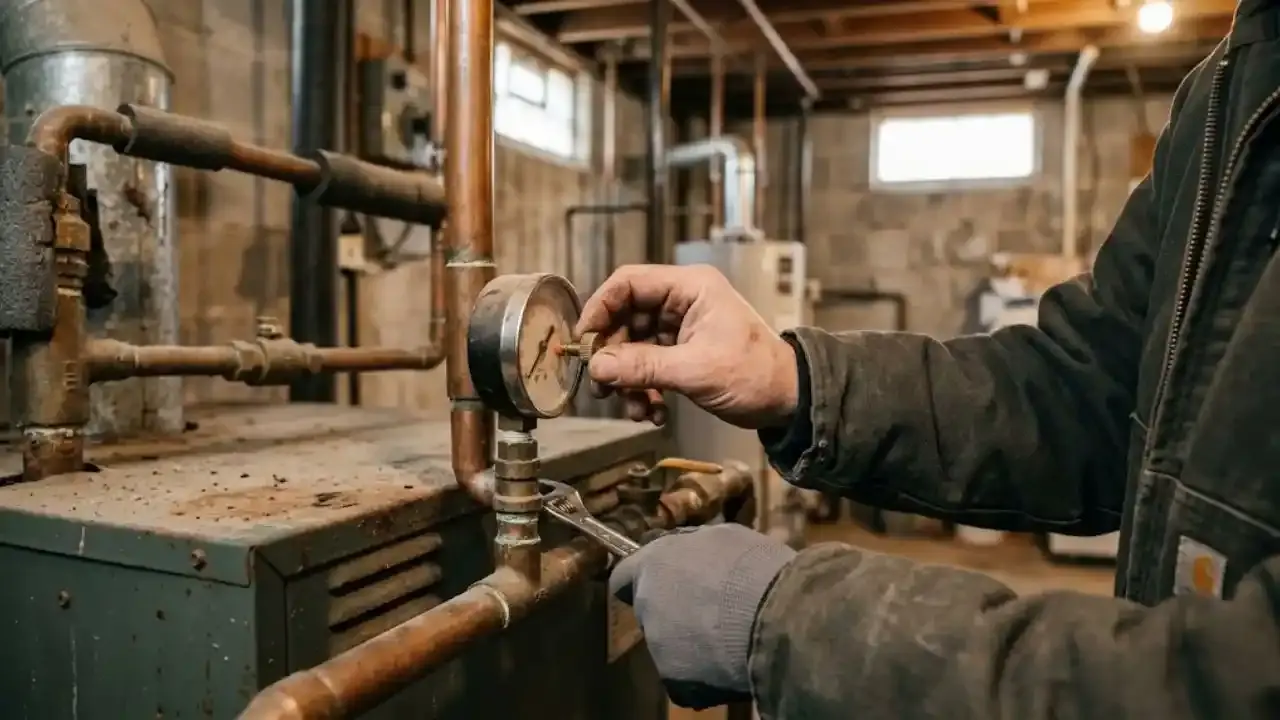
Boiler repair prices range widely because a boiler is a system, not a single part. A failed pump, a bad sensor and a leaking heat exchanger are three very different bills. This guide explains what moves the price in a Savage home and how to decide whether a repair is worth it.
We do not list dollar amounts here, because the right number depends on the unit. What you can learn is how to read the quote, what to ask and when a repair stops making sense.
The part that failed
Most boiler calls fall into a short list of causes. Ignition parts such as igniters, flame sensors and thermocouples wear out. Circulator pumps run constantly and eventually seize. Relief valves and fill valves leak. Expansion tanks lose their air charge. Control boards fail on newer units.
| Failed part | Relative cost | Notes |
|---|---|---|
| Flame sensor or igniter | Low | Common wear item |
| Circulator pump | Moderate | Depends on pump size |
| Relief or fill valve | Low to moderate | Water damage risk if ignored |
| Expansion tank | Low to moderate | Pressure swings are the clue |
| Control board | Moderate to high | Parts can be hard to find on older units |
| Heat exchanger | High | Often a replacement conversation |
Boiler type and age
Older cast iron boilers are tough and simple. Parts are often available, and many run for decades. Newer high-efficiency condensing boilers use complex boards, sensors and condensate traps. They can be efficient, but a board failure costs more to fix.
Age matters mostly for parts. If a manufacturer no longer makes a part for your model, the repair may mean a substitute or a swap. Ask the technician to tell you whether parts are available before you approve work.
Not sure what failed?
Call and we diagnose before ordering anything.
Diagnosis time
Finding the fault takes time on a system with several zones, an indirect water heater or a radiant loop. A technician checks the thermostat, the call for heat, ignition, flow, pressure and exhaust. A visit to diagnose is part of the cost. A good one ends with a cause, not a guess.
When it is a leak
Water around the boiler is a different kind of call. A weeping relief valve or pump flange is repairable. A leak from the heat exchanger or the boiler's jacket means replacement. A leaking boiler that keeps drawing fresh water also introduces new minerals, which speeds scale.
If the loss of water seems unexplained, our leak detection work can trace a hidden leak in the heating loop.
Season and time of day
No-heat calls spike on the first cold nights. After-hours and weekend calls cost more than weekday ones. Annual service in early fall is cheaper than an emergency in January, and it catches worn parts before they fail.
Questions that keep the bill honest
- What exactly failed, and how did you confirm it?
- Is the part new, and what warranty covers it?
- Will the repair bring back full heat, or only get us through the week?
- Are other parts near the end of their life, and what does waiting risk?
- Does the quote include a test cycle and a pressure check?
A technician who can answer these is a technician who found the problem. If an answer is vague, ask for a written description of the finding before you approve a part.
Planning ahead for winter
Boiler failures cluster in the first deep cold of the year, when every system in town is working and every shop is busy. A fall visit lets you choose the day, buy parts without a rush and avoid weekend rates. It also reveals small leaks and weak pumps while the weather is still mild.
Keep the manual, the model number and the last service date near the boiler. That page of paper saves a call-back.
What to know in Savage
Homes in Savage with hydronic heat are served by the same hard supply as the rest of the city. The City of Savage buys about 71.5 percent of its distributed water from Burnsville, whose 2025 report states hardness of 25 to 26 grains per gallon. A boiler that loses water through a leak and refills often will scale faster.
Minnesota's plumbing code is Minnesota Rules chapter 4714, administered by the Department of Labor and Industry. Heating work can involve other trades and permits. Ask the City of Savage building department what applies to your job.
Source type: State agency guide and city water report
Code and sources
According to the Minnesota Department of Labor and Industry, plumbing work in the state follows Minnesota Rules chapter 4714, which incorporates the 2018 Uniform Plumbing Code with Minnesota amendments. Rules for permits and inspections vary by city, so ask your city's building department what your project needs.
Repair or replace: a simple test
- If the boiler is young and the failed part is common, repair.
- If the boiler is old and a second major part has failed this year, consider replacement.
- If the heat exchanger is cracked or leaking, replace.
- If efficiency is poor and the fuel bills are high, ask for a comparison.
- If parts are no longer available, replacement is the honest answer.
Our water heater repair page covers the hot water side of the equipment room, and our Lakeville and Burnsville pages cover the nearby towns where we also work.
Questions Savage homeowners ask
Once a year is a common recommendation, ideally before heating season.
Shut off the water feed and call. A steady leak can damage floors and the boiler.
Air in the system is a common cause. Bleeding can help.
It can scale a heat exchanger, especially if the system takes on a lot of fresh water.
It depends on the job. Ask the City of Savage building department.
Still have a question about your situation? The line is open around the clock. Call (952) 866-9120