
A wet basement has a source. It might be groundwater pushing in at the floor and wall joint, a window well, a cracked wall, a leaking pipe or just humidity. Before anyone quotes you a system, someone should find which it is.
We plan interior drainage, sump placement and moisture control for Savage basements. We also say plainly when the fix is not plumbing, such as grading or gutters, so you do not pay for the wrong solution.
Find the source first
| Clue | Likely source | Best direction |
|---|---|---|
| Water along the floor-wall joint after rain | Groundwater pressure | Interior drain and sump |
| Wet stripe on a wall below a downspout | Surface water at the foundation | Gutters, grading |
| Damp spot far from walls, no rain link | Leaking supply or drain pipe | Leak detection |
| Whole basement clammy in summer | Humidity condensing | Dehumidifier, ventilation |
| Horizontal crack with seepage | Wall pressure | Structural consult |
We start with the cheapest explanations, check pipes with a meter test and look at the exterior grading and downspouts. If the answer is groundwater, we plan a drainage path.
Want a straight answer on your basement?
Call and we look at the source before recommending a system.
Interior drainage systems
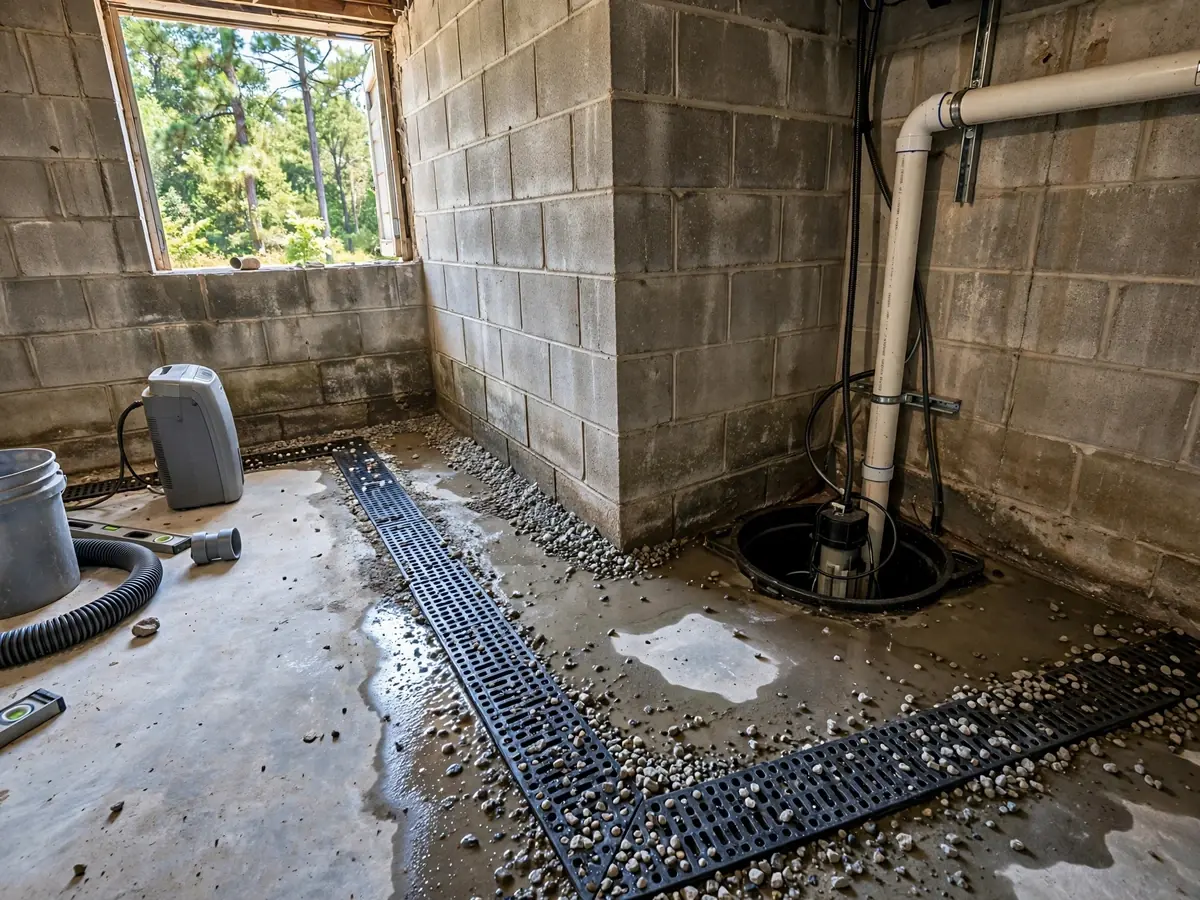
An interior system is a channel at the base of the wall that collects water under the slab edge and carries it to a sump pit. The pump discharges it away from the house. It does not stop water from entering the wall. It gives the water a path so it does not reach the floor.
- 1
Open the slab edge
A strip of concrete along the wall is cut and removed.
- 2
Install drain and gravel
A perforated drain pipe in gravel runs to the sump.
- 3
Set the sump and pump
The pit, pump and discharge line are placed and tested.
- 4
Close and finish
Concrete is patched. Wall finishing is a separate decision.
Exterior vs interior
Exterior waterproofing digs down the outside of the foundation to seal and drain it. It addresses the wall directly but costs far more, disturbs landscaping and often needs more access. Interior systems are the more common choice for retrofits, and exterior work fits when a wall itself has failed.
Savage homes near the Credit River, Eagle Creek and the Savage Fen see seasonal high groundwater. A basement on higher ground may only need good gutters and grading. A basement in a low area often benefits from interior drainage with a pump and backup.
Things you can do this weekend
Before paying for a system, rule out the free causes. Walk the outside of the house during a rainstorm and watch where the water goes. Downspouts should deliver water at least several feet from the foundation. Soil should slope away from the walls. Window wells should drain, and covers keep leaves out.
Inside, check the laundry hose, the water heater, the humidifier and any exposed pipes. A drip tray under a washer that overflows looks the same as seepage. Use a flashlight along the base of each wall at night, when shadows reveal damp patches.
Write down the date, the weather and which wall was wet. That record helps us choose a fix, and it helps an insurer if you make a claim.
Cost factors
Costs depend on length of wall, slab thickness and whether you need a pump. We quote after seeing the space.
Insurance often excludes groundwater seepage. Check your policy for water backup and sump overflow endorsements.
For pump service, see sump pump repair. We help homeowners in Savage and in Lakeville and surrounding towns.
Code and sources
According to the Minnesota Department of Labor and Industry, plumbing work in the state follows Minnesota Rules chapter 4714, which incorporates the 2018 Uniform Plumbing Code with Minnesota amendments. Rules for permits and inspections vary by city, so ask your city's building department what your project needs.
Common questions
Usually yes, with a walkthrough, meter test and exterior check.
It manages water that reaches the base of the wall. It needs a working pump.
If power outages coincide with storms in your area, it is a good idea.
Not humidity. A dehumidifier may still be needed.
Paint can hide seepage but does not control water pressure behind it.
Still have a question about your situation? The line is open around the clock. Call (952) 866-9120